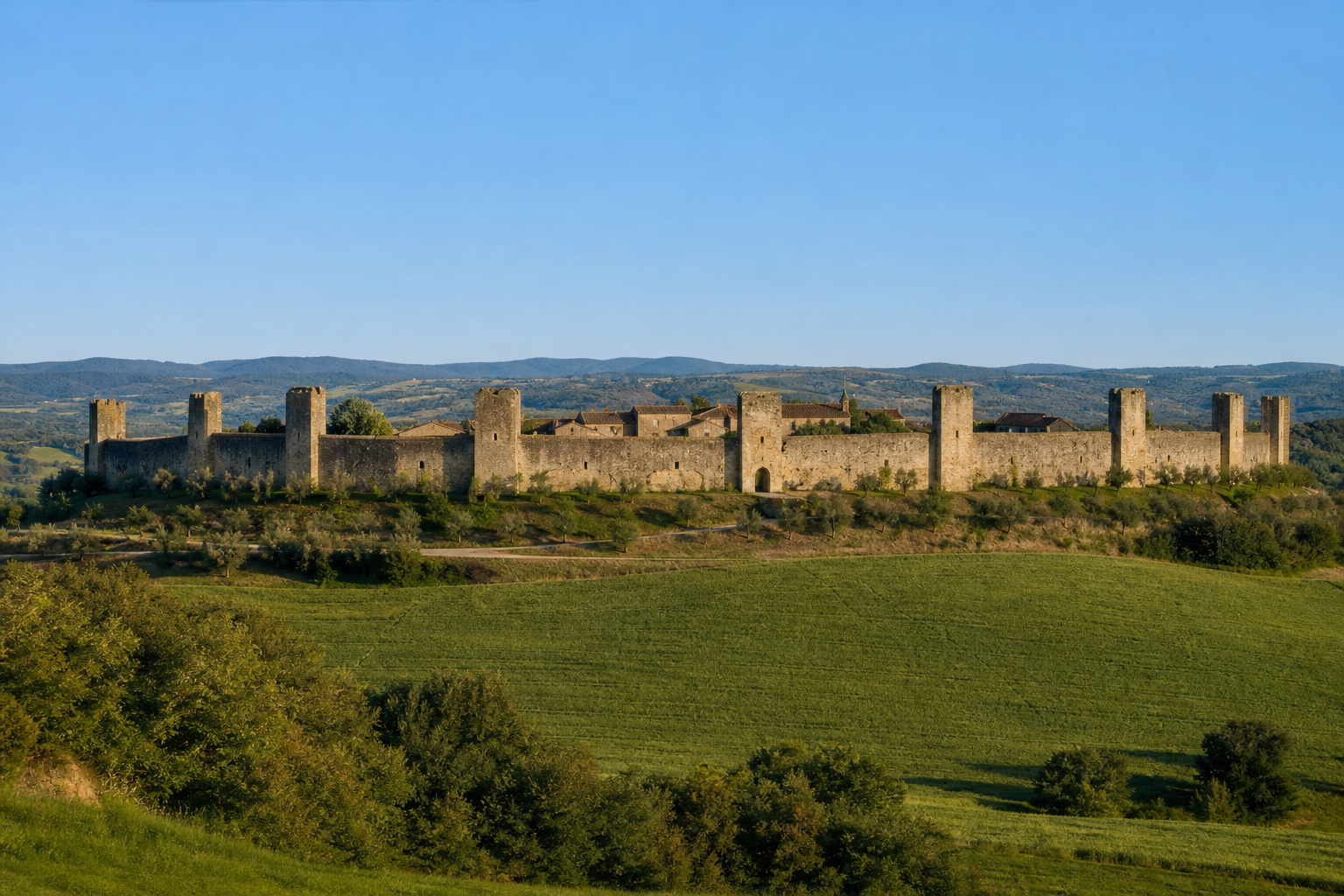
Some places in Tuscany earn their fame through sheer accumulation of art and history. Monteriggioni earns it through a single, arresting act of architectural perfection: a ring of medieval walls, still completely intact after eight centuries, crowned with fourteen towers that rise above the Chianti countryside with such completeness and clarity that first-time visitors sometimes assume they are looking at a restoration. They are not. The walls of Monteriggioni are among the best-preserved medieval fortifications in Europe, and the tiny village they enclose has survived essentially unchanged since the thirteenth century. From Villa Talciona, Monteriggioni is approximately 20 minutes to the south by car, making it one of the easiest and most rewarding half-day excursions available to guests at the villa.
The Walls and Towers: Eight Centuries of Continuity
The fortified village of Monteriggioni was built by the Republic of Siena between 1213 and 1219 as a forward military post protecting the northern approaches to Siena along the Via Cassia, the ancient Roman road that connected Rome to Florence. The construction was rapid by medieval standards: the entire ring of walls, towers, and the village within was completed in a matter of years. The result was a fortification of exceptional regularity: a roughly circular curtain wall punctuated by 14 towers of near-equal height and spacing, enclosing a modest village of a few hundred inhabitants.
The remarkable thing is how completely this configuration has survived. The walls still stand to their original height in most sections. The towers are intact. The single main gate opens onto the Via Cassia below. Walking the external perimeter of the walls takes only about 15 minutes, but the experience of seeing the towers against the Chianti sky from different angles as you walk is one of the most purely visual pleasures in Tuscany.
The interior of the walls is equally striking in its way. The village is tiny: essentially a single main square (Piazza Roma), a Romanesque church (Santa Maria Assunta), a handful of houses, a small wine shop, and a couple of restaurants. The permanent population numbers in the dozens. There is an almost uncanny quality to the silence within the walls on a weekday morning, when you may have the place more or less to yourself.
Dante’s Towers: A Literary Landmark
Monteriggioni is one of those places that gains an additional layer of interest from its literary associations. Dante Alighieri, writing the Inferno section of his Divine Comedy in the early fourteenth century, used the towers of Monteriggioni as a metaphor for the giants guarding the lowest circle of Hell:
“As Monteriggioni, that circles round
its crown with towers, so here above the bank
that moats the pit, with half their bodies, stood
the horrible giants.”
(Inferno, Canto XXXI, translated by Henry Wadsworth Longfellow)
Dante had walked the Via Cassia, as most travellers between Florence and Rome did in his era, and the sight of Monteriggioni’s towers rising above the landscape clearly made an impression powerful enough to inhabit his greatest poem. The passage gives the towers a particular frisson when you stand beneath them, looking up.
What to See Inside the Walls
The Church of Santa Maria Assunta on the main square is a simple Romanesque structure of considerable beauty, and it is almost always quiet. The interior contains a thirteenth-century Madonna and a serene atmosphere that invites a few minutes of contemplation. The church is small and easy to miss if you are moving quickly, but it rewards a stop.
Monteriggioni also has a small but engaging museum dedicated to medieval arms and armour (the Museo Multimediale Monteriggioni di Arme e Mestieri del Medioevo), which uses reconstructions and multimedia displays to bring the medieval period to life in a way that is particularly good for children. The museum occupies a building on the main square and is not large, but it provides good context for what you are seeing in the fortifications outside.
The local wine shop (enoteca) on the main square stocks wines from estates throughout the Chianti Classico and Colli Senesi zones and is an excellent place for a tasting before or after your walk of the walls. The village sits within the Colli Senesi DOC zone and several small estates in the immediate area produce noteworthy Sangiovese wines.
Combining Monteriggioni with a Siena Visit
Monteriggioni sits roughly halfway between Poggibonsi and Siena on the Via Cassia (the old SS2), which makes it an ideal stopping point on the way to or from a day in Siena. The village requires about one to two hours for a relaxed visit including the museum and a coffee on the main square, so a natural itinerary from Villa Talciona might be: drive south from Poggibonsi, stop at Monteriggioni for the morning, continue to Siena for lunch and the afternoon, and return to Talciona in the evening. This gives you two of the most distinctive medieval sites in Tuscany in a single day without feeling rushed.
Alternatively, Monteriggioni makes a good standalone afternoon destination for days when you want something closer to the villa and less demanding than a full city visit.
Practical Information
Monteriggioni is small enough that there are no real practical difficulties. Car parking is available in a small car park just outside the walls, and the village is entirely accessible on foot once inside. There are no ZTL restrictions. Opening times for the museum vary by season so checking in advance is advisable. The village can be extremely busy on summer weekends when it sometimes hosts a medieval festival with costumed events, which is entertaining in its own right but transforms the atmosphere entirely.
From Villa Talciona, a half-day visit to Monteriggioni requires almost no planning. Explore the full range of destinations around the villa to make the most of your stay in Chianti.
Few places in Tuscany offer such a concentrated and immediate encounter with the medieval world as Monteriggioni, and its proximity to Talciona makes it the easiest excursion in this guide. Book Villa Talciona and discover this extraordinary piece of living medieval history just down the road.